
From Maastricht to Capabilities: Reflections on Skills Policy, Then and Now
Read a summary of the closing remarks:
The first – and last – time I visited Maastricht before this conference was in mid-December 2004. It was almost exactly twenty years ago, and the city was hosting an EU summit of Ministers for Education. The meeting aimed to reinforce what had just begun two years earlier with the Copenhagen Process. At that moment, Europe was full of confidence that vocational education and training (VET) could – and should – become a central pillar of European skills policy.
The story is well known. After the Bologna Process had set in motion the harmonisation of higher education structures, the VET world followed with similarly ambitious objectives. Many of the concepts, instruments and policies that still shape our work today were grounded then: the European Qualifications Framework (EQF), credit transfer in VET, quality assurance frameworks, validation of non-formal and informal learning, and the expansion of lifelong learning.
Looking back in VET research
For VET research, Maastricht 2004 was also a turning point. For the first time, a group of research colleagues presented a comprehensive report on the state of VET in Europe. I still vividly remember Tom Leney presenting the study’s findings to an audience of some 500 participants – with a level of intellectual honesty and critical sharpness that was unusual for such a high-level policy event. The long version of that report remains worth reading today.
At the same conference, I had the opportunity to present a project proposing a credit-transfer system for VET – that later received the Leonardo da Vinci Award. Yet, like many promising concepts of that era, it was never fully implemented. Still, the atmosphere was unmistakable: a sense of new beginnings, of a wider Europe, of candidate countries knocking at the door, of new research networks and communities taking shape.
From Skills to Capabilities
Looking back from today, however, I find myself increasingly ambivalent. Over the past two decades, not very much that is genuinely new has happened in European skills policy. Lifelong learning, skills validation, transparency of qualifications, employability – all these were already firmly on the agenda in the early 2000s. What followed was often more of the same, sometimes under new labels. The underlying policy objective remained remarkably stable: how can we make VET more effective and efficient in addressing industry’s skills shortages?
With the Skills2Capabilities (S2C) project, we wanted to push back against this narrow framing – at least a little. The project started from the conviction that vocational education is not merely reacting to labour-market demand, but actively shaping the market, businesses and occupations. We deliberately shifted the analytical lens from skills to capabilities: from isolated skills to people’s ability to navigate transitions, adapt to change, and exercise agency over their working lives.
In this sense, S2C was never just another skills-mismatch project. It examined how VET systems, policies and institutions contribute to – or constrain – the development of capabilities across the life course. It asked what kind of learning environments, governance arrangements and funding mechanisms are needed if workers are expected to manage increasingly fragmented careers.
When I look at the results presented and discussed during this closing event, I believe we have partly succeeded. The project has produced a rich body of empirical and conceptual work, spanning skills demand, VET responsiveness, career guidance, policy design and funding. Yet one single project, even one of this scale, is unlikely to trigger a full paradigm shift. We also still need to learn how to make our findings more visible and more compelling beyond the research community.
Notable Moments During the Project
A project involving around a dozen partner institutions and some 50 researchers inevitably comes with ups and downs – beginnings and endings, joyful and difficult moments. Along the way, TU Dortmund joined the consortium following Philipp Grollmann’s move to a professorship there; KRIVET from Korea became our first non-European partner, marking a small but important step toward global dialogue in VET research. More recently, the German Science Council explicitly praised BIBB’s participation in this project, highlighting both its scientific quality and international relevance.
There were also personal milestones. Giorgio Brunello, who organised the unforgettable project meeting in Venice, has since retired. And there was profound loss: the passing of Ellu Saar, who led the Estonian research team. Ellu was not only an outstanding sociologist; she was the person who first invited me, twenty years ago, to join a project in the predecessor programme of Horizon 2020. Without her, I would not be standing here today.
Results and Outlook
On a more joyful note, the project has already produced around 40 research papers, with many more to follow in 2026 and 2027. Importantly, the collaboration does not end here. Through publications, conferences and new project ideas, the partnership will continue – and unlike in some projects, there is a shared desire to do so.
As we say goodbye to Skills2Capabilities as a formal Horizon project, a brief word of thanks is in order: to our Advisory Board, our partners and national teams, those who ensured dissemination, and the European Commission for its constructive support. Above all, I am grateful to the 3s coordination team who carried this project with professionalism and trust.
Returning to Maastricht after twenty years feels symbolic. Much has changed – yet many questions remain strikingly familiar. If Skills2Capabilities has contributed even a small step toward re-thinking skills policy through the lens of capabilities, learners and workers, then it has been worth the journey.
Jörg Markowitsch, 14 Nov 2025
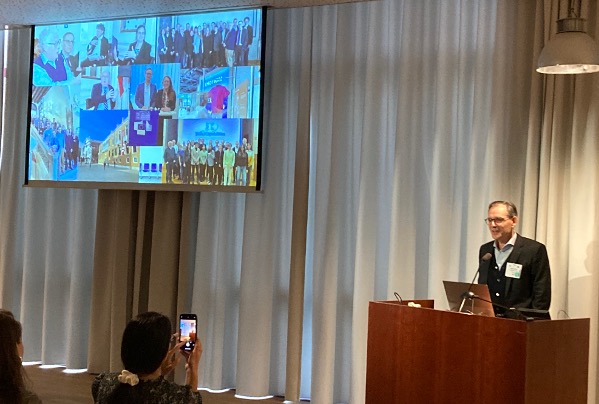
image by Skills2Capabilities
Contact: Jörg Markowitsch
Client: Horizon Europe